
THE CONCRETE SINK: HOW ACCRA’S SPATIAL PLANNING DEFICIT FUELS ITS ANNUAL FLOOD CRISIS
By Ekua Eguakun Esq.,
Every year, between May and July, the headlines across Ghana read with a devastating familiarity: lives lost, properties submerged, commercial hubs paralyzed, and millions of cedis in capital washed away. 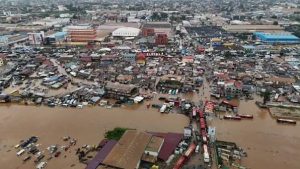
To the casual observer, Accra’s perennial flooding is a natural disaster driven purely by the intensity of West African torrential rains however as a legal practitioner dealing directly with land law and land disputes I see a far more reality of negligence and systemic failure; Accra’s flooding crisis is not an act of God. It is a man-made crisis manufactured by a chronic deficit in spatial planning, systemic non-compliance with the Land Use and Spatial Planning Act, 2016 (Act 925), and the unregulated expansion of our built environment.
To understand why the capital city, submerge with every heavy downpour, we must look past the clogged drains and analyze the structural failure of our spatial layout
1. Building on the Waterways
The fundamental rule of hydrology is simple: water will always find its path. Yet, across Greater Accra, physical structures sit directly inside that path. Under Act 925, the Land Use and Spatial Planning Authority is mandated to protect ecological buffers, green belts, and natural floodplains from human encroachment. On the ground, however, an administrative vacuum has allowed rapid unzoned development to overtake vital wetlands.
During the dry season, landowners sell off these cheap, dried-up swamp zones to eager developers. Because many peripheral areas completely lack a proper zoning scheme, developers build massive warehouses, residential estates, and commercial structures without realizing they are plugging a natural drain. When the rainy season peaks, these buildings act as concrete dams, forcing stormwater backward into local communities and creating instant, catastrophic flash floods.
2. The Loss of the “Sponge”: Hyper-Concrete Urbanization
A healthy city requires a balance between porous green surfaces that absorb water and concrete surfaces that repel it. Over the last two decades, Accra has transformed into a massive concrete sink. Due to the lack of strict enforcement of spatial green-space ratios by local Municipal and District Assemblies residential yards, parks, and natural vegetation have been systematically replaced by paving blocks, asphalt, and concrete foundations. In prime, high-density residential and commercial hubs nearly 100% of rainwater becomes instant surface runoff. Millions of gallons of water rush over paved compounds
and race into a municipal drainage network that was engineered decades ago for a fraction of the current urban population. The math is simple: the volume of runoff vastly outstrips the volumetric capacity of the drains, leading to immediate overflow.
3. “Build First, Regularize Later”: The Permitting Collapse
Section 113 of Act 925 explicitly states that no physical development can commence without a written Development Permit from the local Municipal /District Assembly. If enforced, this law would act as a structural gatekeeper, preventing any illegal or dangerous building from scratching the soil.
Instead, the prevailing market culture in Accra is to bypass the local assembly entirely, build the structure, and wait to negotiate regularization fines later. Local authorities often turn a blind eye during the foundation stage, only launching enforcement actions after an asset is significantly complete. This reactive enforcement means that by the time an assembly notices a structure blocking a critical water channel—the building is already standing. Tearing it down requires heavy municipal budgets, legal battles, and political will that local assemblies rarely possess. Consequently, illegal, water-blocking structures remain standing for years, continuously endangering entire neighborhoods.
4. Fragmented Governance and the Lack of Master Planning
Accra’s urban sprawl has rapidly outpaced its administrative boundaries. Today, the capital is carved up into several independent Local Authorities, each managing its own zoning approvals.
This fragmentation prevents a cohesive, basin-wide flood management strategy. If an upstream local authority grants building permits in an unzoned valley without coordinating with the downstream authority, downstream communities pay the price in devastating floods. Without a single, unified, and digitally enforced master plan across the entire Greater Accra region, flood mitigation remains an exercise in futility
5. Moving Forward: The Legal and Structural Fix
We cannot engineer our way out of Accra’s floods purely by digging deeper concrete gutters or unblocking silted drains. True flood mitigation requires a return to the rule of law in our land administration.
a. Metropolitan, Municipal and District Assemblies must transition from passive “penalty collection” agencies to proactive enforcement authorities, utilizing drone technology and Geographic Information Systems mapping to stop unauthorized construction at the foundation stage.
b. Traditional stools, clans and families must be legally held to their fiduciary duties under Section 13 of the Land Act 2020, by penalizing sellers/venfors who knowingly sell designated ecological buffer zones to unsuspecting buyers.
c. Real estate investors must expand their due diligence. A clean Land Title Certificate only proves ownership; it does not protect your asset from being reclaimed by water or demolished by the state for blocking a waterway.
Conclusion
Until our spatial planning frameworks dictate our physical development—rather than our physical development overriding our planning frameworks, Accra will continue to wash away its economic gains with every passing storm.